 Nadia Patel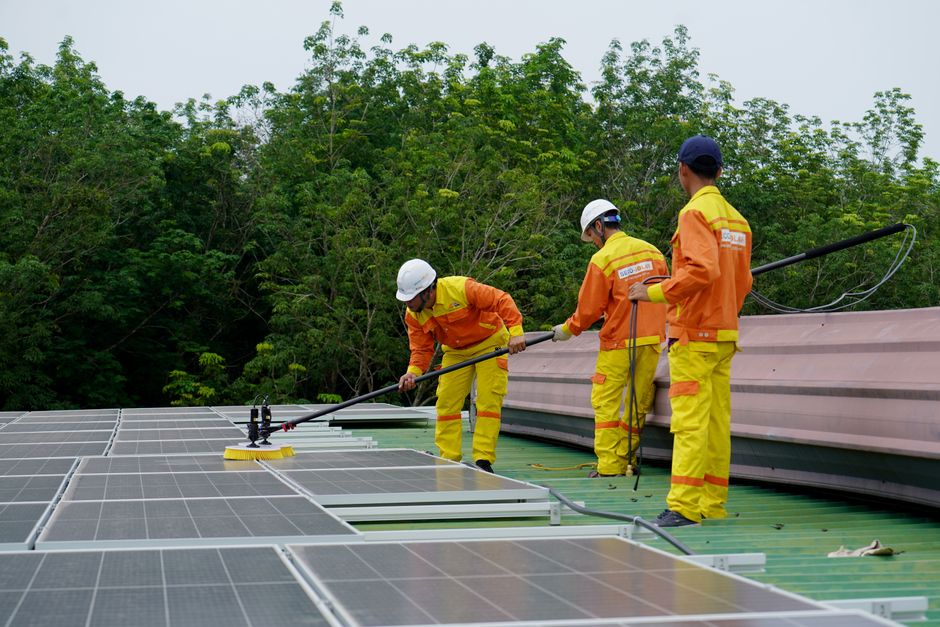
$0.53. That’s how much of every dollar you spend on a residential solar installation actually goes to paying the workers who show up, climb on your roof, and physically bolt panels to your house. The rest goes to equipment, permits, overhead, and margin. I spent weeks digging into labor cost breakdowns because I kept getting vague answers from installers, and what I found genuinely changed how I evaluate quotes.
Most homeowners fixate on the total system price, which is fair. But understanding the labor slice matters a lot, because it’s the piece that varies most between competing quotes, and it’s the piece where you can actually get taken advantage of without knowing it. Equipment prices are relatively transparent. Labor markups are not.
Let me show you what the numbers actually look like.
- Labor typically costs $0.50–$1.00 per watt, or roughly 10–15% of a total solar installation quote
- A standard 8 kW residential system runs $4,000–$8,000 in labor alone before incentives
- Labor costs vary significantly by state, roof type, and system complexity, not just installer margin
- The 30% federal Investment Tax Credit applies to the full installed cost, including labor
- Getting 3+ quotes can reveal labor markup gaps of $2,000–$4,000 on identical systems
What You’re Actually Paying For
When an installer quotes you $28,000 for a 10 kW system, the labor portion is somewhere between $5,000 and $10,000 depending on where you live, your roof, and the company’s overhead structure. According to EnergySage’s market data, the national average installed cost sits around $2.85 per watt before incentives as of this year. Labor accounts for roughly $0.50 to $1.00 per watt of that, based on installer cost breakdowns I’ve reviewed across dozens of projects.
What does that labor actually include? More than most people expect. You’re paying for the site assessment and roof inspection, the permit application (which can take anywhere from 2 days to 6 weeks depending on your jurisdiction, and someone has to manage that back-and-forth), the physical installation crew, electrical work by a licensed electrician, utility interconnection paperwork, and the final inspection walkthrough. When I’ve asked installers to line-itemize this for me, the physical installation crew time is usually only about 60% of the labor charge. The rest is project management, permitting, and coordination that nobody talks about.
Here’s something installers don’t volunteer: roof penetrations are where roof warranties get complicated, and the skill level of the crew doing them matters enormously. A rushed crew with a high-volume installer doing three jobs a day is not the same as a smaller company doing one. I’d rather pay $500 more for someone who takes their time with the flashing.
The Numbers, State by State
Helpful resource: Lutron Caséta Wireless Smart Dimmer Kit is a top-rated option for this. (As an Amazon Associate this site earns from qualifying purchases.)
Labor costs don’t move in a straight line with cost of living. California has high labor rates but also incredibly efficient permitting in some counties, which can partially offset the hourly cost difference. Hawaii is eye-watering. Texas tends to run lean. Here’s how current (July 2026) labor costs break down across major markets, drawing from NREL’s residential solar cost benchmark reports:
| State | Avg. Labor Cost per Watt | Labor Cost on 8 kW System | Notes |
|---|---|---|---|
| California | $0.85–$1.05 | $6,800–$8,400 | High wages, variable permitting |
| Texas | $0.50–$0.70 | $4,000–$5,600 | Lower wages, fast permits in many counties |
| Florida | $0.60–$0.80 | $4,800–$6,400 | Hurricane strapping adds labor time |
| New York | $0.90–$1.10 | $7,200–$8,800 | Strong union presence, complex interconnection |
| Arizona | $0.55–$0.75 | $4,400–$6,000 | Efficient market, high competition |
| Massachusetts | $0.85–$1.00 | $6,800–$8,000 | High wages, strong incentives offset cost |
| Hawaii | $1.10–$1.40 | $8,800–$11,200 | Highest labor market in the country |
What these ranges mean for you practically: if you’re in New York and getting a quote with labor priced below $0.75/watt, ask why. If you’re in Arizona and seeing labor quoted above $1.00/watt, you’re either being overcharged or your roof is genuinely complex.
What Drives Labor Costs Up
I’ve seen quotes for nearly identical system sizes come in $4,000 apart on labor alone. Here’s what’s actually driving that spread.
Roof type is the biggest variable most people underestimate. A simple single-story ranch with a south-facing asphalt shingle roof takes a crew about 6–8 hours to install. A two-story home with a complex hip roof, tile or slate shingles, and multiple obstructions? That same crew is there for 12–16 hours, and the tile-removal-and-replacement work alone can add $1,500–$3,000. I’ve seen tile re-roof add-ons priced as a separate line item, and I’ve also seen installers quietly bundle it into a high base labor rate to obscure the markup.
Electrical complexity is another real factor. If your main panel needs upgrading to accept the new solar production capacity, that’s typically $1,500–$3,500 in additional electrical labor, separately quoted. Most installs on homes with a 200-amp panel are straightforward. Older homes with 100-amp service almost always need the upgrade. Story from a reader in Sacramento: she was quoted $31,000 total for her system, but didn’t realize the panel upgrade was excluded until week three of the project. Tack on $2,400.
Battery storage adds meaningful labor hours too. Adding a single Tesla Powerwall or similar 13 kWh battery typically adds $800–$1,500 in installation labor beyond the unit cost, mostly for the electrical integration and load management wiring.
Worked example 1: 6 kW system on a simple asphalt shingle gable roof in Phoenix, straightforward 200-amp panel, single-story. Crew arrives at 7 a.m., done by 2 p.m. Total labor charge: $3,900 ($0.65/watt). Makes sense.
Worked example 2: Same 6 kW system in Portland, two-story home, concrete tile roof, 125-amp panel requiring upgrade. Installation takes two days. Labor charge: $8,200 ($1.37/watt plus $1,400 panel upgrade line item). Also makes sense, though the homeowner was shocked.
Worked example 3: 10 kW system in New Jersey with battery backup (two Powerwall 3 units), complex interconnection with the local utility requiring three separate inspection visits. Total labor: $13,500 before the panels or batteries. That number sounds alarming until you realize the interconnection alone involved four visits from a licensed electrician plus a project coordinator burning about 12 hours on paperwork.
The Federal Tax Credit Changes Everything
I’ll be honest, I used to tell people to focus on the net-of-incentives cost before even thinking about labor breakdown. I’ve updated that view slightly. The 30% federal Investment Tax Credit applies to the complete installed cost, including all labor. That means a $7,000 labor charge costs you $4,900 after the credit. High labor quotes sting less with that math, but they still matter because the credit only works if you have sufficient federal tax liability to claim it, and many retirees or low-income households don’t. The U.S. Department of Energy’s homeowner guide has a clear breakdown of how this calculation works, and it’s worth reading before you assume you’ll capture the full 30%.
One thing I didn’t fully appreciate until I dug into it: the credit doesn’t reduce your total cost automatically. It reduces your tax bill in the year you claim it. If your tax liability is $3,000 and your credit is $8,400, you’ll roll the remainder forward, but that means your year-one cash benefit is less than you might expect.
How to Actually Evaluate a Labor Quote
Ask for a labor line item specifically. Not all installers will give you one, but the good ones won’t hesitate. If a company bundles everything into a single per-watt price and refuses to break out labor, that’s a yellow flag. Not a dealbreaker, but worth pushing.
Compare crews, not just companies. When I sit with homeowners reviewing quotes, I ask each installer: how many people are on your typical install crew? How many installs do they run per week? A four-person crew doing two installs per week is a very different animal from a two-person crew doing five. Neither is automatically better, but it tells you something about the quality-versus-volume tradeoff.
Get three quotes minimum. EnergySage’s data consistently shows that homeowners who collect three or more quotes save an average of $5,000 to $10,000 on their total system cost. Much of that gap is labor pricing. I’d set a specific floor: don’t sign anything until you have at least three written quotes with itemized labor.
What surprised me when I started asking for labor breakdowns more aggressively was how often the “premium” installer and the budget installer had nearly identical equipment specifications but a $3,500 gap in labor. Sometimes that gap reflects genuine quality differences. Sometimes it’s just margin. You can’t know which without asking.
Sources
- NREL Residential Solar–Photovoltaic System Cost Benchmark: Annual benchmark report on installed cost components including labor, overhead, and equipment by system size and state
- EnergySage Solar Marketplace Intel Report: Consumer-facing market data on average system costs, quote comparisons, and installer pricing across U.S. markets
- U.S. Department of Energy: Homeowner’s Guide to Going Solar: Official DOE guidance on costs, incentives, and the federal Investment Tax Credit
- Solar Energy Industries Association (SEIA) U.S. Solar Market Insight: Industry-level data on installation volume, pricing trends, and workforce
- Lawrence Berkeley National Laboratory: Tracking the Sun: Long-term dataset on residential PV installed prices including labor components
Photo: Trinh Trần via Pexels
Recommended Resources
Disclosure: As an Amazon Associate, we earn a small commission from qualifying purchases at no extra cost to you. We only recommend products that genuinely support the topics covered in this article.
- Renogy 200W Solar Starter Kit + 30A Charge Controller (~$169), Complete beginner solar kit, 200W monocrystalline panel, charge controller, and mounting hardware included.
- EF EcoFlow DELTA 2 Portable Power Station (1024Wh) (~$599), 1024Wh LFP battery with 1800W output, top-rated solar generator for home backup power. Charges in under 2 hours.
- Renogy 2×100W Monocrystalline Solar Panels (~$99), Expandable 200W panel set from the most trusted DIY solar brand, used widely in off-grid and home backup systems.