 Derek Hansen
Most solar calculators are built by installers who want to sell you a system. That’s not a conspiracy theory, it’s just business. When the default output of a “free calculator” is always “yes, solar makes sense for you,” you should wonder what variable they’re rounding in your favor.
Here’s how to actually size a solar system, using real math, so you can walk into any installer conversation already knowing what a reasonable proposal looks like.
Start With Your Electricity Bill, Not Your Roof
The most common mistake I see homeowners make is leading with roof space. They climb up there (or Google Earth their address), count the square footage, and work backward. Wrong direction entirely.
Your electricity consumption drives system size. Everything else is a constraint you work around later.
Pull your last 12 months of utility bills and find your total annual kilowatt-hour (kWh) usage. Don’t average a few months. Do the full year, because summer AC or winter heat pumps will throw off any shorter window. The national residential average sits around 10,500 kWh per year according to the Solar Energy Industries Association (SEIA), but that number is nearly useless for your specific situation. A 900-square-foot condo in San Diego and a 2,800-square-foot house in Houston are not the same problem.
If you can’t find 12 months of bills, your utility’s online portal almost always has usage history going back two or three years. Log in and get the actual number.
The Core Calculation (It’s Four Steps)
| Location | Peak Sun Hours/Day | Annual Usage Example | System Size Needed | Panel Count (400W) |
|---|---|---|---|---|
| Charlotte, NC | 4.8 | 12,000 kWh | 8.5-9 kW | 21-23 |
| Phoenix, AZ | 6.5 | 12,000 kWh | 6.3-6.8 kW | 16-17 |
| Seattle, WA | 3.5 | 12,000 kWh | 12.4-13.3 kW | 31-33 |
Helpful resource: EG4 Battery Monitor Shunt for Solar Systems is a top-rated option for this. (As an Amazon Associate this site earns from qualifying purchases.)
Once you have your annual kWh, the math is straightforward. I’ll walk through it with a real example: a household using 12,000 kWh per year in Charlotte, North Carolina.
Step 1: Find your peak sun hours. This isn’t total daylight hours. It’s the equivalent number of hours per day when sunlight intensity hits 1,000 watts per square meter. Charlotte averages about 4.8 peak sun hours per day. Phoenix runs closer to 6.5. Seattle scrapes by at around 3.5. NREL’s PVWatts tool is the most reliable free source for this number by zip code, and it’s what most serious installers actually use.
Step 2: Calculate daily kWh needed. 12,000 kWh per year ÷ 365 days = 32.9 kWh per day.
Step 3: Account for system losses. Real solar systems lose energy to heat, wiring resistance, inverter conversion, and the occasional cloud. A standard efficiency derate is about 80% (or a 0.8 multiplier). So your system needs to produce 32.9 ÷ 0.8 = 41.1 kWh per day under ideal conditions.
Step 4: Divide by peak sun hours. 41.1 kWh ÷ 4.8 peak sun hours = 8.6 kilowatts (kW) of system capacity needed.
So this Charlotte household needs roughly an 8.5 to 9 kW system to fully offset their usage. At a typical panel wattage of 400W today, that’s 21 to 23 panels.
Run the same math for your numbers. The formula is always: (Annual kWh ÷ 365 ÷ 0.8) ÷ Peak Sun Hours = System Size in kW.
The Variables That Can Swing Your Number by 30%
Don't Get This Wrong: How to Size Your Solar Inverter Perfectly · Gary Does Solar ☀️ on YouTube
The formula above gives you a starting estimate. These factors will either push it up or pull it down, sometimes significantly.
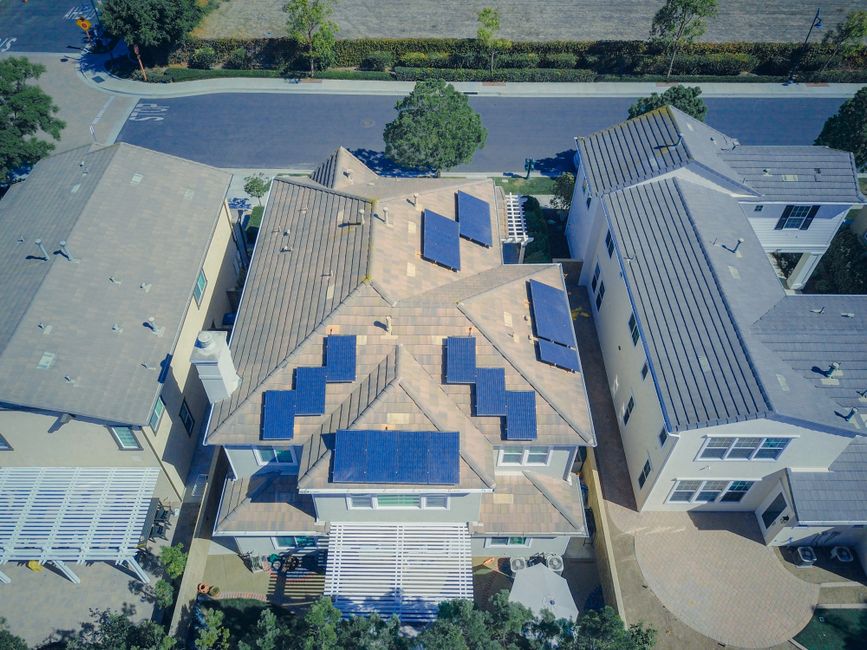
Roof orientation and tilt. South-facing at a 30-degree pitch is the ideal in the Northern Hemisphere. An east-west split isn’t terrible, you lose maybe 15-20% production versus due south. A north-facing roof is genuinely a problem in most of the U.S., and no amount of panel upsizing fully compensates for it.
Shading. One oak tree that drops a shadow on three panels from 10am to noon can cut system output by 15% or more. If you have meaningful shading, your installer should be using software like Aurora or Shade Report to model it. If they’re eyeballing it, that’s a problem. For shaded roofs, microinverters (like Enphase IQ8 series) or power optimizers (SolarEdge) allow each panel to operate independently. Worth knowing before you get quotes.
What you’re trying to offset. Most utilities don’t pay you the full retail rate for excess power you export to the grid. Net metering policies vary dramatically by state, and they’ve been getting less generous. In California, the current NEM 3.0 policy slashed export credits by roughly 75%. If you’re in a state with weak net metering, sizing your system to 80-90% of usage often pencils out better than going for 100% offset, because you’re not overproducing energy you’ll get paid pennies for.
Future load changes. Planning to buy an EV in the next two years? Adding a heat pump? These aren’t small additions. A Level 2 EV charger can add 3,000 to 4,500 kWh per year depending on how much you drive. Size for where your usage is going, not just where it’s been.
What the Quotes Will Actually Show You
Once you have your own estimate, you can read installer proposals intelligently. EnergySage’s market data consistently shows that getting three or more competing quotes saves homeowners an average of 10% on system cost. That’s real money at current prices of roughly $2.80 to $3.20 per watt installed before the federal tax credit.
If a proposal comes in significantly larger than your calculated size, ask why. “Bigger is better for resale” and “this covers future usage” are both ways to sell you capacity you don’t need. Sometimes the reasoning is valid. Sometimes it isn’t.
The 30% federal investment tax credit is still in place through at least 2032 under current law. On a $28,000 system, that’s $8,400 back in your pocket at tax time, though you need a sufficient tax liability to use it fully.
A home energy monitor like the Emporia Vue (affiliate link) installed before you go solar gives you a much sharper picture of where your kWh are actually going. I’ve had readers discover that an old chest freezer in the garage was adding 1,200 kWh per year to their bill. Replacing it before sizing a system saved them more than a panel’s worth of capacity.
Sources
- the Solar Energy Industries Association (SEIA)
- EG4 Battery Monitor Shunt for Solar Systems
- EnergySage’s market data
- Emporia Vue
- Govee WiFi Smart Plug with Energy Monitoring
Disclosure: As an Amazon Associate, we earn a small commission from qualifying purchases at no extra cost to you. We only recommend products that genuinely support the topics covered in this article.
- Renogy 200W Solar Starter Kit + 30A Charge Controller (~$169), Complete beginner solar kit, 200W monocrystalline panel, charge controller, and mounting hardware included.
- EF EcoFlow DELTA 2 Portable Power Station (1024Wh) (~$599), 1024Wh LFP battery with 1800W output, top-rated solar generator for home backup power. Charges in under 2 hours.
Recommended Resources
Disclosure: As an Amazon Associate, we earn a small commission from qualifying purchases at no extra cost to you. We only recommend products that genuinely support the topics covered in this article.
- Renogy 200W Solar Starter Kit + 30A Charge Controller (~$169), Complete beginner solar kit, 200W monocrystalline panel, charge controller, and mounting hardware included.
- EF EcoFlow DELTA 2 Portable Power Station (1024Wh) (~$599), 1024Wh LFP battery with 1800W output, top-rated solar generator for home backup power. Charges in under 2 hours.